




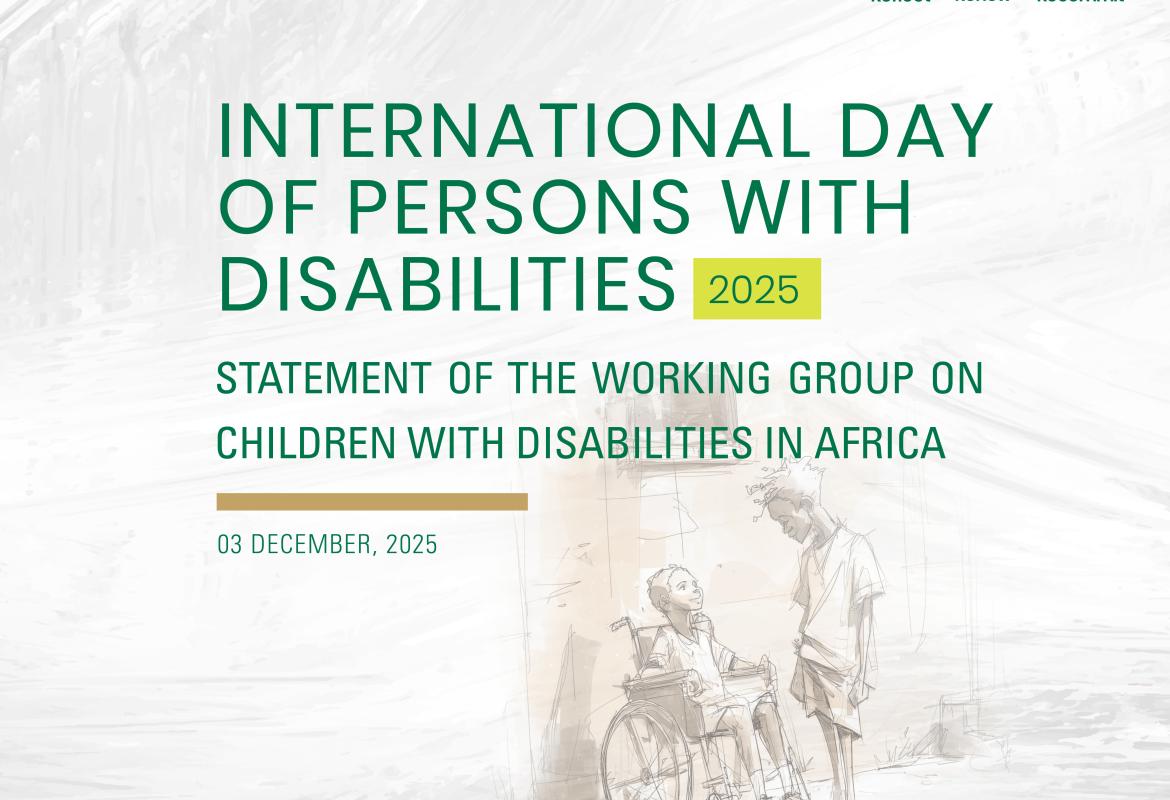
On this International Day of Persons with Disabilities, the Working Group on Children with Disabilities of the African Committee of Experts on the Rights and Welfare of the Child (ACERWC) calls upon all African Union Member States, National Human Rights Institutions (NHRIs), civil society organizations (CSOs), communities, and all stakeholders to recommit to the urgent task of building societies where every child with a disability can belong and thrive, free from discrimination, exclusion, and neglect.
This year’s theme, “Fostering Disability-Inclusive Societies for Advancing Social Progress,” resonates deeply with our mandate. True social progress in Africa cannot be measured by economic indicators alone; it must be gauged by the well-being, inclusion, and active participation of all its children, especially those with disabilities. An inclusive society is a fundamental precondition for sustainable and equitable development.
There is limited reliable data on the actual numbers of children with disabilities, especially in Africa. Nevertheless, we know that children with disabilities are a significant proportion of the population, which translates into millions. In the East and Southern Africa region alone, UNICEF data estimates the number of children with disabilities to be up to 29 million. These numbers support the call for an inclusive society.
Article 13 of the African Charter on the Rights and Welfare of the Child provides the right of children with disabilities to special measures of protection in keeping with their physical and moral needs and under conditions which ensure their dignity, promote self-reliance and active participation in the community. Guided by this provision, the Working Group emphasizes that special measures for the full participation of children with disabilities entails fostering transformative shift from discriminatory perceptions and viewing children with disabilities as burden to recognizing them as rights-holders with agency, voices, and immense potential.
To further advance this vision, the Working Group urges Member States to prioritize the following key areas:
Inclusive Education: We call for the elimination of physical, communication, and attitudinal barriers that prevent children with disabilities from accessing quality, and inclusive education. This requires investing in teacher training, accessible learning materials, inclusive curricula, and assistive technologies. Education is an essential tool for the empowerment and participation for children with disabilities.
Inclusive Health Services: Children with disabilities must have access to the same range, quality, and standard of affordable health care as other children, including early identification, intervention, and rehabilitation services.
Protection from Violence, Abuse, and Harmful Practices: Children with disabilities face a heightened risk of violence, exploitation, and neglect. We urge States to establish child protection systems that include responses to children with disabilities in their design, ensuring they are inclusive and accessible. This includes training social workers, police, and judiciary personnel on disability rights, and establishing safe, disability-inclusive reporting mechanisms.
Ensuring the Right to be Heard: Fostering an inclusive society means actively listening to children with disabilities. We must create spaces and provide the necessary support for them to express their views freely on all matters affecting their lives, and ensure their opinions are given due weight in accordance with their age and maturity. To this end, child participation platform should be inclusive of children with all types of disabilities; information should be accessible in disability friendly manner; and decision-making processes should incorporate consultation of children with disabilities in matters affecting them.
Empowering Families and Communities: Families and caregivers of children with disabilities need support, not stigma. We encourage programs that provide parents with information, training, and resources to become effective advocates for their children. Community-based awareness campaigns are crucial to challenge negative stereotypes and promote a culture of inclusion from the grassroots level.
The Working Group also calls on NHRIs, CSOs, OPDs, academia, and other stakeholders to ensure that their respective interventions and advocacy for an inclusive society integrate the rights and freedoms of children with disabilities.
On this day, let us remember that the exclusion of children with disabilities results in a profound loss of human potential for our continent. Building disability-inclusive societies is not only a legal obligation; it is a strategic investment for a brighter, more prosperous, and harmonious Africa.
The Working Group on Children with Disabilities stands ready to support all stakeholders in this critical endeavour. Let us work together to turn the promise of inclusion into a tangible reality for every child with a disability in Africa.